Physical AI and IoT: Why Resilient Network Connectivity Is the Real Bottleneck

How ultra-resilient, low-latency connectivity, from SD-IoT and IoT gateways to private 5G, decides whether Physical AI scales beyond the pilot.
For most of its history, artificial intelligence lived behind glass, answering questions and sorting images from inside a data center, safely removed from the physical world it was reasoning about. That era is ending. AI is now climbing out of the server rack and into machines that move and decide in real time: autonomous forklifts threading crowded warehouse aisles, rail-inspection systems judging track wear at speed, robotaxis merging into traffic, and humanoids stepping off the demo reel and onto the factory floor. Analysts have a name for the shift, Physical AI, and they expect the market to grow from roughly $1.5 billion in 2026 to more than $15 billion by 2032, a compound rate near 47%.
Buried inside every Physical AI roadmap is a quiet assumption worth saying plainly: a robot is only as intelligent as its connection to the world around it. The most advanced model on the planet is useless to an autonomous vehicle if the network drops for two seconds at the wrong moment. That part rarely makes the keynote slides, and it is exactly where the conversation needs to go next.
What Is Physical AI — and Why It Depends on the Network
When people picture Physical AI, they picture the machine itself: the arm, the wheels, the on-board chip. The hardware has come a long way, and neural processing units are now cheap and power-efficient enough to put real inference capability directly onto an excavator or an inspection camera. But intelligence at the edge does not mean the edge works alone.
A Physical AI system runs on a constant negotiation between what the machine can decide locally, what it needs from the cloud or a campus server, and how fast that exchange happens, and every one of those exchanges rides on a network. Coordinating a fleet of autonomous mobile robots, streaming LiDAR and video for remote oversight, pushing a model update to a hundred machines at once, or pulling a safety-critical command down in milliseconds, none of it happens without connectivity that is fast, predictable, and reliable.
Why Connectivity, Not Compute, Is the Real Bottleneck for Physical AI
Reliability is the hard part. Consumer connectivity is built for good enough, and a dropped video call is only a nuisance, but Physical AI cannot afford good enough, because a dropped connection can mean a stalled production line, a collision, or a safety event. The intelligence has moved to the edge, and the resilience has to move with it.
The machines are mobile, so the network has to be too. An autonomous vehicle in a port doesn’t sit still on one clean Wi-Fi signal; it crosses between indoor and outdoor coverage, between Wi-Fi and private cellular, through zones where any single link will eventually weaken. Treat connectivity as one static pipe and the machine will outrun it.
What Resilient Connectivity for Autonomous Machines Requires: Hybrid Wi-Fi, Private 5G, and Failover
The workable answer is hybrid and redundant by design, combining Wi-Fi, private LTE/5G, and wired backhaul so that no single point of failure can strand a machine mid-task. Handover has to stay seamless as a robot moves from a warehouse into a yard, with no dropped session (RAD demonstrates exactly this with automated guided vehicles crossing between private 5G and Wi-Fi). Latency has to stay low and predictable, so a command lands in the same tight window every time rather than usually, and security has to live in the connection itself, because a fleet of networked autonomous machines is also a fleet of attack surfaces, often sitting on critical infrastructure.
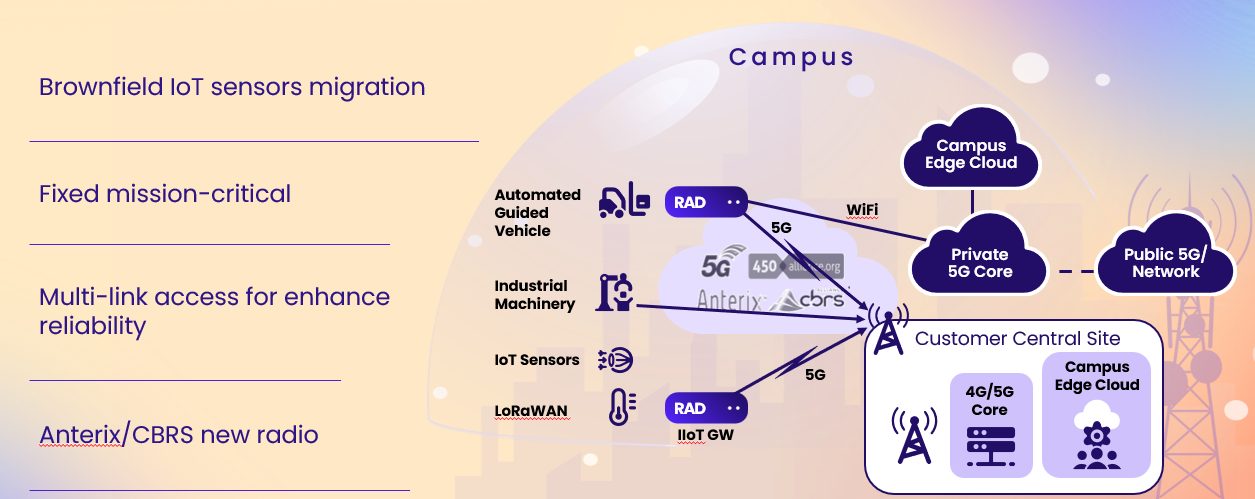
On a live campus, autonomous machines move constantly between Wi Fi and private 5G, RAD’s IoT gateways keep the connection to the edge cloud unbroken as they go.
None of this is glamorous, but it is the difference between a pilot that dazzles in a controlled demo and a deployment that survives a real facility on a bad day.
How RAD’s SD-IoT and IoT Gateways Support Physical AI
For more than four decades, RAD has been keeping the operational networks it builds running when the stakes are highest and failure is not an option, in power grids, on rail, and across utilities and connected industry.
RAD’s software-defined IoT approach, SD-IoT, was built for the demands Physical AI now imposes. It delivers ultra-resilient connectivity through multiple Layer 2 and Layer 3 tunnels across public and private LTE and 5G, with packet-by-packet traffic steering, load balancing, and packet duplication for zero packet loss, while double redundancy and failover keep service running when a link degrades. RAD’s IoT gateways let an autonomous machine move between indoor Wi-Fi and outdoor 5G without losing a deterministic, low-latency path back to campus- or cloud-hosted applications, and they carry embedded security so protection travels with the connection instead of bolting on afterward.
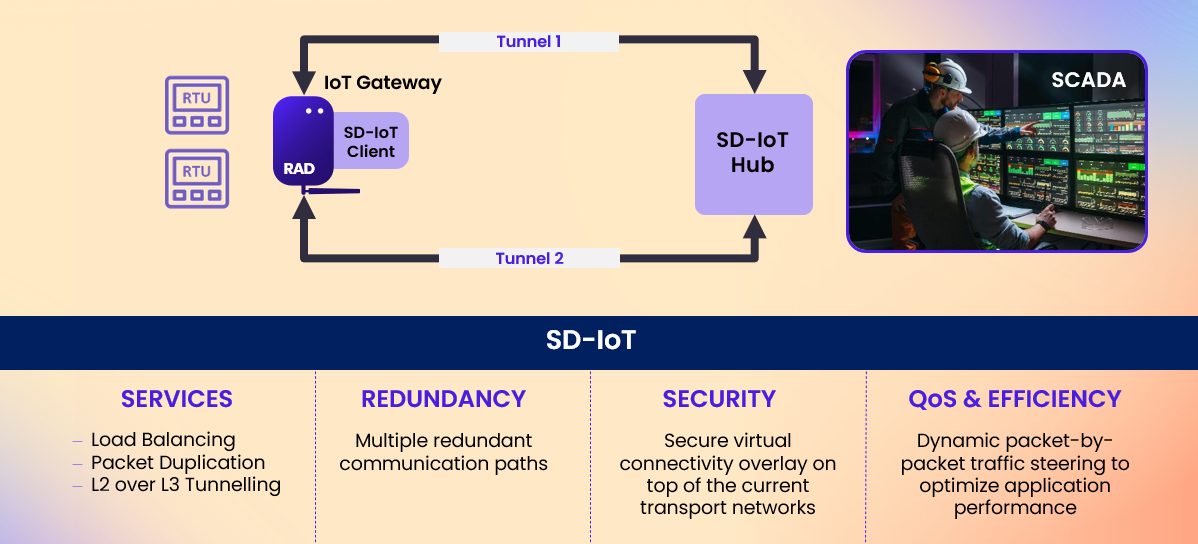
SD-IoT delivers ultra-resilient connectivity via dual tunnels, packet duplication, and packet-by-packet steering, so a link failure never becomes a service failure
While much of the industry races to make machines smarter, RAD works on making them trustworthy, matching the intelligence at the edge with a connection that behaves the same way at 2 a.m. in the rain as it does in a demo.
Key Takeaway: Connectivity Is the Scarce Resource in Physical AI
Physical AI will reshape the coming decade, but the winners won’t be decided by who has the cleverest model or the most capable robot. They’ll be decided by who can keep tens of thousands of autonomous machines connected, coordinated, and secure, continuously and without exception.
Intelligence is becoming abundant; reliable, secure, real-time connectivity is the scarce resource. The operators who treat the network as strategic infrastructure, rather than something bolted on once the robots are chosen, are the ones whose Physical AI ambitions will actually leave the lab.
In the physical world, “mostly connected” is not a strategy. It’s a countdown.