Sovereign Connectivity


For most of the internet era, connectivity was treated as a commodity. A packet’s job was to get from A to B as fast and cheaply as possible, and the path it took in between was somebody else’s problem. That assumption is quietly breaking down. As data becomes the most regulated asset a business owns, the question is no longer only how fast it moves, but where it goes, who can see it, and under whose laws it travels. Welcome to the era of sovereign connectivity.
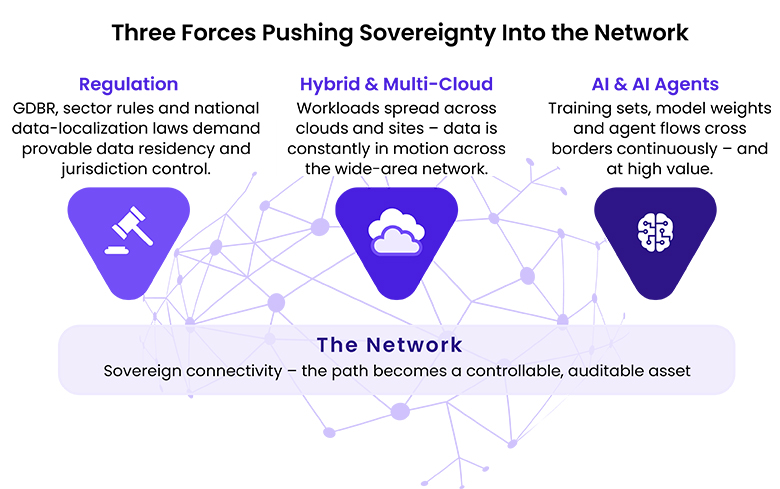
Sovereign connectivity is the principle that the network itself, not just the data centers at either end, must respect jurisdiction. It is the natural extension of data sovereignty into the layer that has, until now, been deliberately borderless: The transport in between. And it is fast becoming a board-level concern, because three forces are converging at once.
Three forces pushing sovereignty down into the network
The first is regulation. Data-protection regimes such as GDPR, sector rules in finance and healthcare, and a growing wave of national data-localization laws all share a common demand: Organizations must be able to prove where regulated data resides and control the jurisdictions it crosses. As RAD has argued, private cloud access is emerging as a key to data sovereignty precisely because the public internet cannot make that guarantee. The internet’s ubiquity is its strength and, for compliance, its weakness. Once data leaves a local network it may traverse multiple jurisdictions with no enforceable control over the path.
The second is the shift to hybrid and multi-cloud. Enterprises now spread workloads, datasets, and compute across private clouds, public hyperscalers, and remote sites, which means an unprecedented volume of sensitive enterprise data is constantly in motion across the wide-area network rather than sitting safely inside a data center. Every one of those movements is a potential sovereignty and compliance event.
The third, and most disruptive, is AI. Distributed and federated AI architectures move enormous training datasets, model weights, and inference traffic between sites, and increasingly, autonomous AI agents generate continuous, latency-sensitive flows between clouds, tools, and enterprise systems. These aren’t ordinary workloads. The data in transit frequently includes proprietary model weights and regulated training data, exactly the kind of material an organization cannot afford to see leak across an uncontrolled path.
Why the public internet can’t deliver sovereignty
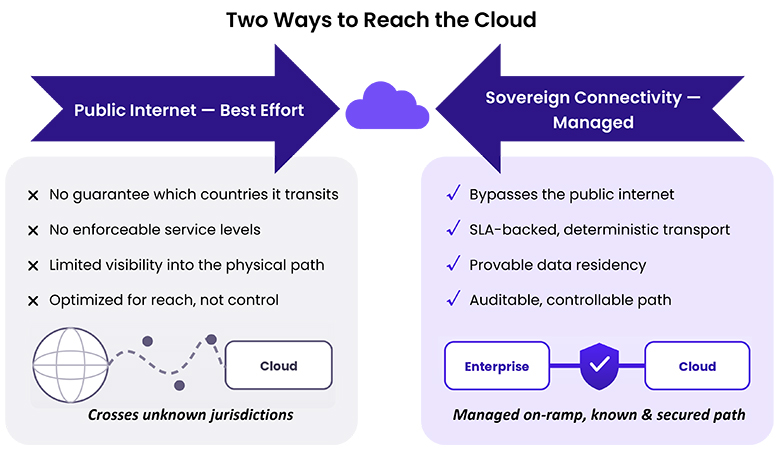
The uncomfortable truth is that the design that made cloud computing ubiquitous is the same design that makes sovereignty hard. Best-effort internet routing optimizes for reach, not for control. It offers no guarantee about which countries a flow will transit, no enforceable service levels, and limited visibility into the physical path data actually takes.
Sovereign connectivity flips the priority. It treats the path as a controllable, auditable asset. In practice that means bypassing the public internet in favor of managed carrier and hyperscaler networks, through direct, carrier-managed cloud on-ramps or dedicated VPNs into cloud locations, so that an enterprise can say with confidence where its data goes and who touches it along the way. This is where the network edge becomes strategic rather than incidental.
The carrier edge is where sovereignty gets enforced
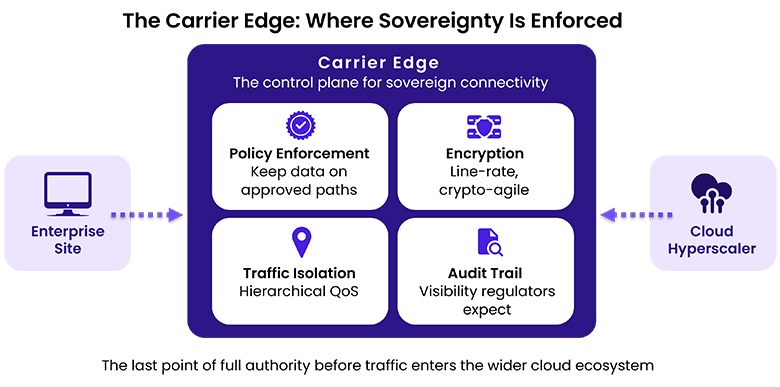
The point where an enterprise site connects to the carrier network, the carrier edge, is emerging as the natural control plane for sovereign connectivity. It is the last place an organization has full authority over its traffic before that traffic enters the wider cloud ecosystem, which makes it the logical place to enforce policy, apply encryption, isolate sensitive flows, and generate the audit trail that regulators expect.
RAD makes this argument directly in its work on Carrier Ethernet for AI: Carrier Ethernet provides the control and visibility needed to enforce policies over the physical path data takes in motion, “something that cloud-native connectivity often cannot guarantee.” That single sentence captures the sovereign-connectivity thesis. Deterministic, SLA-assured transport with rich operational visibility isn’t just a performance feature — it is the mechanism by which an organization exercises jurisdiction over its own data.
For AI in particular, this matters twice over. The same carrier-edge capabilities (hierarchical quality of service, strict traffic isolation, fine-grained classification) that keep latency-sensitive agent traffic from being disrupted by bulk transfers are also what allow sensitive AI data to be kept on approved, auditable paths. Sovereignty and performance stop being a trade-off and start being two outcomes of the same architecture.
Sovereignty is also a service opportunity
There is a commercial reading of all this that service providers should not miss. For years, connectivity, including data center interconnect, was sold largely on price. Sovereign connectivity changes the conversation. Enterprises moving regulated data and valuable AI assets across the network will pay for guaranteed paths, compliance-grade controls, and provable data residency in a way they never paid for raw bandwidth. Sovereignty, in other words, is a premium managed service waiting to be productized. Providers who can offer jurisdiction-aware, SLA-backed, encrypted connectivity are positioned to differentiate on trust rather than compete on cost.
Where RAD fits
RAD’s carrier-edge and Carrier Ethernet for AI portfolios are built around exactly these needs. Its Ethernet Access Devices already underpin private cloud access services, providing the managed, high-performance connectivity that keeps enterprise traffic off the public internet. At the higher end, platforms such as the ETX-2i deliver SLA-assured transport with hierarchical QoS to isolate sensitive flows, line-rate encryption, and a crypto-agile design that anticipates post-quantum threats — the building blocks of a connection an organization can actually stand behind when a regulator asks.
The strategic point is bigger than any single device. As data becomes more regulated and AI pushes more of it across borders, the network is no longer neutral plumbing. It is a place where compliance is either enforced or lost. Organizations that recognize this early — and the providers who serve them — will treat connectivity not as a commodity to be minimized, but as a sovereignty control to be designed. That is the shift sovereign connectivity represents, and it is already underway at the edge.